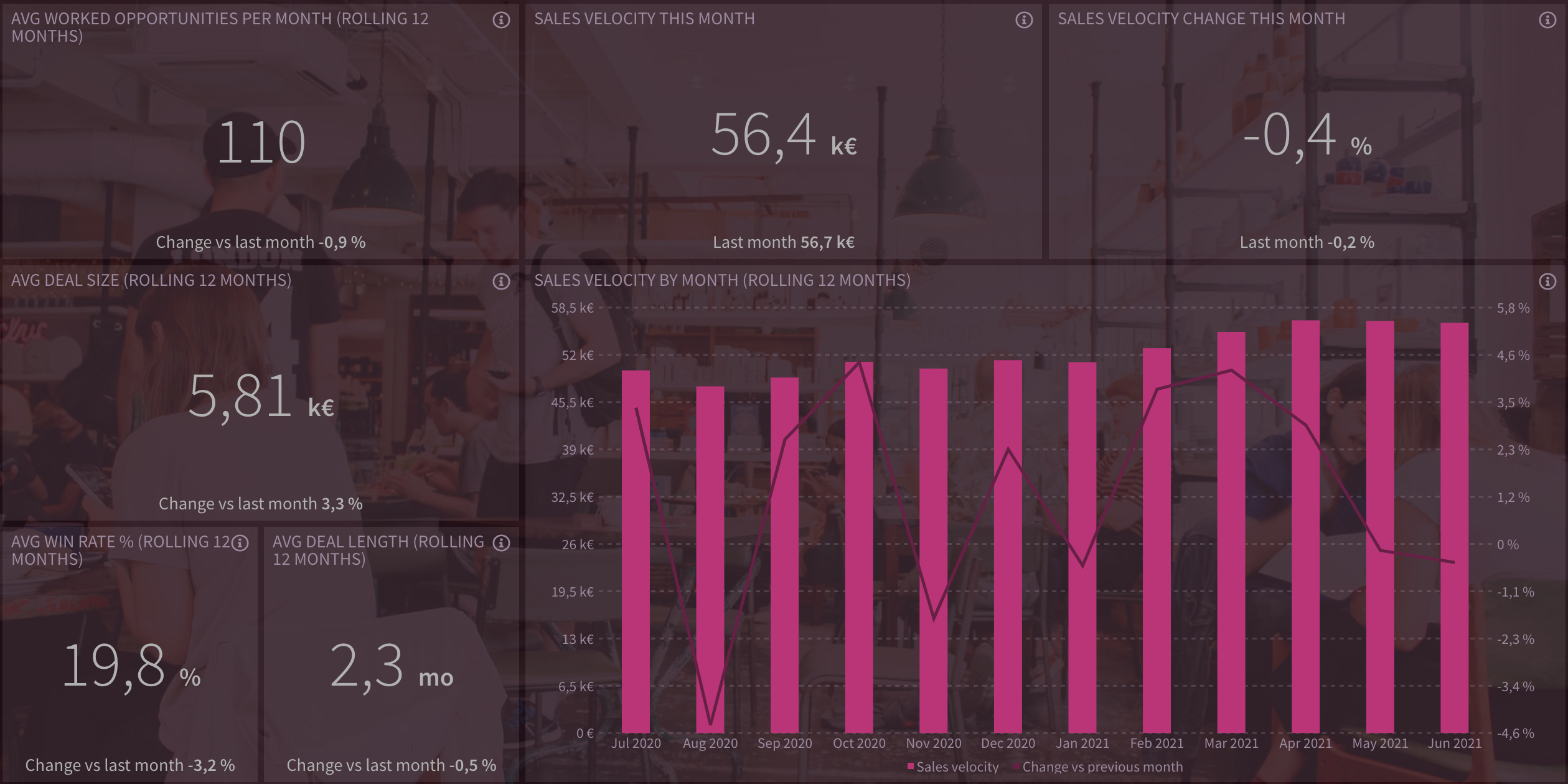
Dear Lucy's Sales Velocity metric is available to all of our clients that have a CRM integration, without the need to conduct any calculations themselves.
What is it?
Contrary to what the name of the metric implies, Sales Velocity does not mean the average deal length of your opportunities from open to close date, rather it is a measurement of how fast your sales organization is making money.
The metric looks at how fast your leads are moving through your pipeline and how much revenue new customers provide over a given period of time.
Sales Velocity offers a way to gauge the health of your sales operation. It is based on a simple formula that helps companies to measure their sales productivity, or effectiveness of the sales operation.
How is it calculated?
The Sales Velocity Equation helps companies focus on just 4 variables that drive sales velocity (sales productivity): the Number of deals in play, the Deal size, the Win rate and the Sales cycle length.
Sales Velocity = ((Average number of Worked Opportunities in a month x Average Deal Size x Average Win Rate) / Average Deal Length)
The 4 variables
Average number of Worked Opportunities per month:
Using the number of closed cases over the last 12 months (won and lost), per month: Number of closed cases / 12
Average Deal Size:
Using the number of closed won cases over the last 12 months, per month: Sum of the value of all won cases / number of won cases
Average Win Rate %:
Using the number of closed won cases over the last 12 months, per month: Number of won deals / number of closed deals (won and lost)
Average Deal Length:
Using data from the past 12 months, deal length is calculated by looking at how many days each deal has between its open date to its close date, and is then converted into a monthly value in Dear Lucy (30.4 days per month on average). The average deal length is subsequently calculated from the Sum of the combined deal length / number of deals (won and lost).
Dear Lucy's Sales Velocity vs other variations of Sales Velocity:
Dear Lucy's way to calculate Sales Velocity stays true to the source of the equation, which was developed by Altify. Rather than just using the number of open opportunities as the first variable, which is the case in versions of the equation, Dear Lucy uses the average number of worked opportunities per month. What this means is that we calculate how many deals are closed (won or lost) on average every month. This is a true measure of how many opportunities your sales team is able to work through on a given month.
This has a large impact of the result of the equation. If you use the number of open opportunities you are likely to have an inflated result as there can be a large number of opportunities in the pipeline that are unlikely to ever convert. Even if you segment this and only look at qualifies leads, there is no guarantee that your sales team will be able to work on and close the deal.
Dear Lucy has changed one part of the equation, however, in the sense that we have converted the Average Deal Length on a monthly level, rather than a daily level. This allows us to provide a value for Sales Velocity on a monthly level, which in our view is more comprehensible for many of our clients. It is easier to put into context the value of dollars per month, than dollars per day.
How to use Sales Velocity?
The metric provides most value when it is used to evaluate whether changes in the sales process lead to improved sales effectiveness over time. Small percentage changes in the 4 variables (see above), can have large positive or negative impact on Sales Velocity. The actual amount of Sales Velocity in Dear Lucy tells you how much sales you'll generate in an average month, but it's typically more valuable to look at the change in the four variables, and how they impact the Sales Velocity.
For this reason, Dear Lucy also indicates the %-change for all the variables, as well as for Sales Velocity itself, in order to make it easy for our customers to see how improvements in one or two of the factors can have a disproportionate positive impact on Sales Velocity.
Example:
In the case below, the company's Sales Velocity is as follows in January:
- Average number of worked opportunities per month = 100
- Average deal size = 80,000 €
- Average win rate = 40%
- Average deal length = 1.5 months
- Sales Velocity = ((100 x 80,000 x 0,4)/ 1.5) = 2,133,333.00 €
Now, after a number of efforts to the sales process, focusing on increasing the win rate by having more meetings with the prospects and shortening the deal lengths by dismissing more leads that don't meet the ideal customer profile, the company increases it's win rate to 50% (+20%) and the average deal length is decreased to 1.25 months (-16,7%) after three months.
The new Sales Velocity 3 months later is then:
- Average number of worked opportunities per month = 100
- Average deal size = 80,000 €
- Average win rate = 50% (20% increase)
- Average deal length = 1.5 months (-16.7% decrease)
- Sales Velocity = ((100 x 80,000 x 0,5)/ 1.25) = € 3,200,000.00 (50% increase!)
How can I start using Sales Velocity?
Dear Lucy's solution for Sales Velocity has been designed to work for all of our customers without any set-up time needed. However, should certain tweaks be needed or required, we're of course happy to do these as well to ensure that the metric fits our customers processes.
Our Sales Velocity metrics are available to all our clients on one of our current plans and can be implemented to their dashboards with a push of a button.
Comments
0 comments
Article is closed for comments.